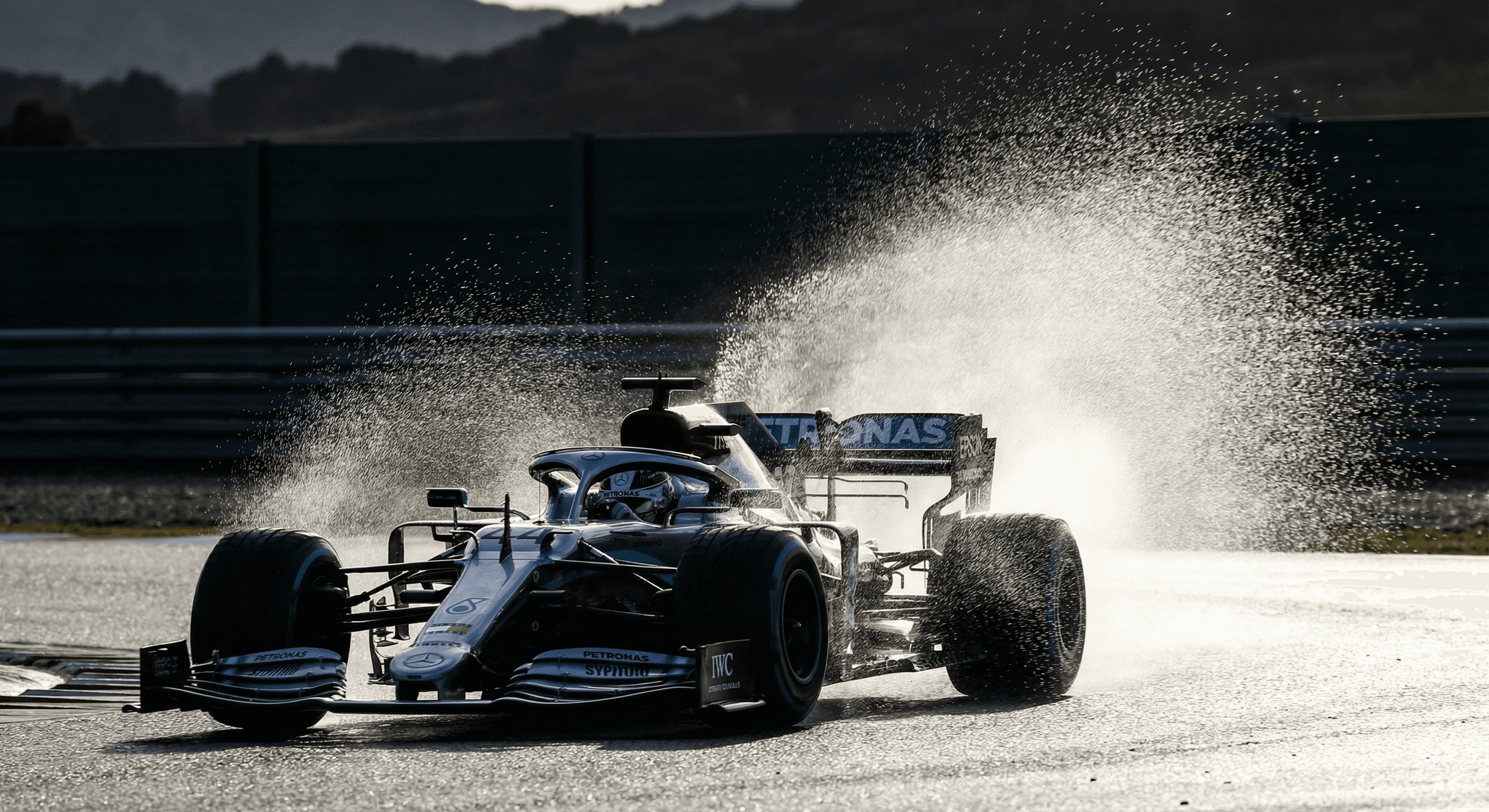
The Problem (The Old Way)
Beginners make two common shutter speed mistakes:
Too slow: You shoot at 1/500s thinking "that's fast enough"—but your F1 car at 280 km/h is a blurry streak across the frame. Subject motion blur ruins the shot.
Guessing randomly: You try 1/1000s, 1/1250s, 1/2000s without understanding why. Sometimes it works, sometimes it doesn't. Zero consistency, wasted shots.
Ignoring direction: You use the same shutter speed whether the car is coming toward you or crossing perpendicular. Direction of motion matters—a lot.
Result: Hit-or-miss photography. You can't deliver consistently sharp images because you're guessing instead of calculating.
The Solution (The Smart Way)
Freezing action is physics, not luck:
Shutter Speed Formula:
- Head-on approach: 1/500s - 1/1000s (subject moving TOWARD you = less apparent motion)
- 45-degree angle: 1/1000s - 1/1600s (medium apparent motion)
- Perpendicular (broadside): 1/2000s - 1/4000s (maximum apparent motion, hardest to freeze)
Subject speed matters:
- Slow (cyclists, runners): Halve the shutter speeds above
- Medium (touring cars, rally): Use speeds above as-is
- Fast (F1, MotoGP, NASCAR): Double the shutter speeds above
Distance matters:
- Close (10-20m): Use faster shutter (more apparent motion)
- Far (50m+): Can use slower shutter (less apparent motion)
Understand these relationships, and you'll get sharp action shots consistently.
Step-by-Step Shutter Speed Guide
Step 1: Identify Your Scenario
Before choosing shutter speed, categorize your shot:
Direction of motion:
- Head-on: Car approaching camera directly → Easiest to freeze
- Receding: Car moving away → Also easy (same as head-on)
- Diagonal (45°): Car crossing at angle → Medium difficulty
- Perpendicular: Car crossing broadside → Hardest to freeze
Subject speed:
- Category 1 (slow): Cyclists, runners, karts (under 80 km/h)
- Category 2 (medium): Touring cars, rally, amateur racing (80-150 km/h)
- Category 3 (fast): F1, MotoGP, NASCAR, WEC (150-350 km/h)
Your distance:
- Close: 10-30 meters (pit lane, start/finish, tight corners)
- Medium: 30-60 meters (typical spectator distance)
- Far: 60m+ (long lens from grandstand or barriers)
Step 2: Calculate Your Minimum Shutter Speed
Use this quick reference chart:
CLOSE DISTANCE (10-30m):
| Direction | Slow (80 km/h) | Medium (150 km/h) | Fast (300 km/h) |
|---|---|---|---|
| Head-on | 1/500s | 1/800s | 1/1250s |
| Diagonal (45°) | 1/800s | 1/1600s | 1/2500s |
| Perpendicular | 1/1600s | 1/2500s | 1/4000s |
MEDIUM DISTANCE (30-60m):
| Direction | Slow (80 km/h) | Medium (150 km/h) | Fast (300 km/h) |
|---|---|---|---|
| Head-on | 1/400s | 1/640s | 1/1000s |
| Diagonal (45°) | 1/640s | 1/1250s | 1/2000s |
| Perpendicular | 1/1250s | 1/2000s | 1/3200s |
FAR DISTANCE (60m+):
| Direction | Slow (80 km/h) | Medium (150 km/h) | Fast (300 km/h) |
|---|---|---|---|
| Head-on | 1/320s | 1/500s | 1/800s |
| Diagonal (45°) | 1/500s | 1/1000s | 1/1600s |
| Perpendicular | 1/1000s | 1/1600s | 1/2500s |
Pro tip: These are MINIMUM shutter speeds. Faster is always safer—use the chart as your baseline, then add 1-2 stops for insurance.
Step 3: Configure Camera Settings
Set your camera for optimal frozen-action shooting:
Mode: Shutter Priority (Tv/S)
- Locks shutter speed (you control motion blur)
- Camera auto-adjusts aperture for correct exposure
ISO:
- Sunny conditions: 400-800 (allows fast shutter without wide aperture)
- Overcast/shade: 1600-3200 (enables fast shutter in less light)
- Use Auto ISO with minimum shutter speed set to your calculated value
Aperture (camera will set, but expect):
- f/2.8 - f/5.6 in bright light (even with fast shutter)
- f/2.8 - f/4 in shade/overcast (wider to maintain shutter speed)
Drive Mode:
- High-speed continuous (20+ fps if available)
- Maximizes chance of perfect timing
Focus Mode:
- AI Servo / Continuous AF
- Zone or 3D tracking (tracks moving subjects)
Step 4: Shoot & Review
Fire burst mode as subject passes:
- Track subject early: Start tracking 2-3 seconds before shutter press
- Fire burst: Hold shutter through entire subject pass (20-50 frames)
- Immediate review: Zoom to 100% on camera LCD
- Check critical sharpness: Is the driver's helmet sharp? Car number legible? Sponsor logos crisp?
If subject is blurry:
- Increase shutter speed by 1 stop (1/2000s → 1/4000s)
- Try next vehicle with faster setting
If perfectly sharp:
- You can experiment going slower (for lower ISO/better exposure latitude)
- But don't risk it if light is good—stay fast
Step 5: Balance Depth of Field vs Shutter Speed
Fast shutter speeds force wider apertures = shallow depth of field:
At 1/4000s, f/2.8:
- Pros: Frozen action, beautiful background blur (subject isolation)
- Cons: Thin focus plane (if car is angled, rear might be soft)
Solution options:
- Accept shallow DOF: Embrace bokeh, focus on driver/front of car
- Add light: Use flash (fill or main) to allow faster shutter at smaller aperture
- Increase ISO: Allows smaller aperture (f/5.6) while maintaining fast shutter
Most pros choose: Shallow DOF (f/2.8 - f/4) for frozen motorsport action—background blur adds drama and isolates subject.
Freezing Specific Motorsport Scenarios
Formula 1 / Open-Wheel Racing
Speeds: 250-350 km/h on straights, 100-180 km/h in corners
Recommended shutter speeds:
- Straight broadside: 1/3200s - 1/4000s
- Corner exit (45°): 1/2000s - 1/2500s
- Head-on straight: 1/1000s - 1/1600s
Bonus challenge: Spinning wheels
- Front/rear wheels rotating = motion blur even at 1/4000s
- This is NORMAL and actually desirable (shows car is moving)
- Chassis should be frozen, wheels can have slight blur
MotoGP / Motorcycle Racing
Speeds: 200-350 km/h, extreme lean angles
Recommended shutter speeds:
- Apex lean (perpendicular): 1/2500s - 1/4000s
- Straight (broadside): 1/3200s minimum
- Head-on braking: 1/1250s - 1/2000s
Special consideration:
- Rider's body extends beyond bike—larger subject area
- Use faster shutter than equivalent car speed (more to freeze)
Rally / Off-Road Racing
Speeds: 80-150 km/h (varies dramatically by terrain)
Recommended shutter speeds:
- Gravel spray freeze: 1/2000s - 1/3200s (freeze individual rocks)
- Jump landing (perpendicular): 1/1600s - 1/2500s
- Sliding corner: 1/1250s - 1/2000s
Creative alternative:
- Mix frozen-action (1/2000s) with motion blur (1/320s) across the event
- Variety shows different aspects of rally (speed + motion)
NASCAR / Oval Racing
Speeds: 280-320 km/h on tri-ovals, 150-200 km/h on short tracks
Recommended shutter speeds:
- Pack racing (broadside): 1/3200s - 1/4000s
- Pit road: 1/800s - 1/1250s (much slower speeds)
- Banking shots (45° angle): 1/2000s - 1/2500s
Pro Tips for Frozen-Action Mastery
Lens selection:
- 70-200mm f/2.8: Versatile, fast aperture helps with fast shutter
- 400mm f/2.8 / 600mm f/4: Pro choice (expensive but unbeatable)
- 100-400mm f/4.5-5.6: Budget option (need higher ISO for fast shutter)
Stabilization:
- Turn OFF image stabilization (IS/VR/VC) when using 1/1000s+ shutter
- At those speeds, stabilization is unnecessary and can cause artifacts
Continuous shooting buffer:
- Frozen-action means shooting 20-40 frame bursts
- Use fast memory cards (UHS-II minimum, CFexpress better)
- Camera buffer depth matters (50+ RAW burst is ideal)
Exposure compensation:
- Fast shutter + wide aperture = potential overexposure in bright sun
- Use -1/3 to -2/3 EV compensation
- Underexpose slightly, recover in post (protects highlights)
When to Use Frozen-Action vs Panning
Both techniques have their place:
Use frozen-action when:
- ✓ You want crisp details (sponsor logos, car liveries, driver faces)
- ✓ Shooting from head-on angles (panning doesn't work here)
- ✓ Creating images for technical analysis or publications
- ✓ You need consistent results (panning is hit-or-miss)
Use panning when:
- ✓ You want to convey speed and motion
- ✓ Creating artistic/dynamic images
- ✓ Shooting from broadside angles
- ✓ Background is distracting (motion blur simplifies it)
Pro workflow: Shoot BOTH at every location
- 50 frozen-action frames at 1/3200s
- 50 panning frames at 1/200s
- Gives clients variety, maximizes publishable shots
Common Questions (FAQ)
Q: Why are my photos sharp but the wheels are blurry? A: Wheels rotate independently of car chassis. At 300 km/h, wheels spin ~50 revolutions/second—even 1/4000s won't fully freeze them. This is normal and actually desirable (shows motion). Focus on chassis sharpness.
Q: Do I really need 1/4000s? My camera only goes to 1/8000s. A: 1/4000s is sufficient for 99% of motorsport. You'd only need faster (1/8000s) for extreme situations: very close distances (<5m), or propeller/wheel blur reduction in specific scenarios.
Q: How do I get fast shutter speeds on dark/overcast days? A: Raise ISO. Modern cameras (2020+) handle ISO 6400-12800 cleanly. Better to have sharp image with slight noise than blurry image with clean ISO 400. Noise is fixable in post, motion blur is not.
Q: Should I use electronic or mechanical shutter for frozen-action? A: Electronic shutter eliminates shutter shock (tiny blur from mechanical curtain movement). If your camera offers 20+ fps electronic shutter with no rolling shutter issues, use it. Otherwise, mechanical is fine at these speeds.
Tag 2,000 photos in 25 minutes
RaceTagger's AI organizes race photos by driver/car number automatically. Focus on shooting, not sorting.
Start Free →Bottom Line
Freezing action in motorsport isn't about maxing out your shutter speed dial—it's about understanding the relationship between subject speed, direction of motion, and distance.
The formula:
- Identify scenario (speed, direction, distance)
- Calculate minimum shutter speed from charts above
- Add 1 stop safety margin
- Shoot burst, review at 100%, adjust if needed
Follow this process, and you'll deliver sharp motorsport images consistently — no more guessing, no more motion-blurred failures.
RaceTagger AI organizes every shot automatically, so you can focus on the next event instead of tagging photos for hours.